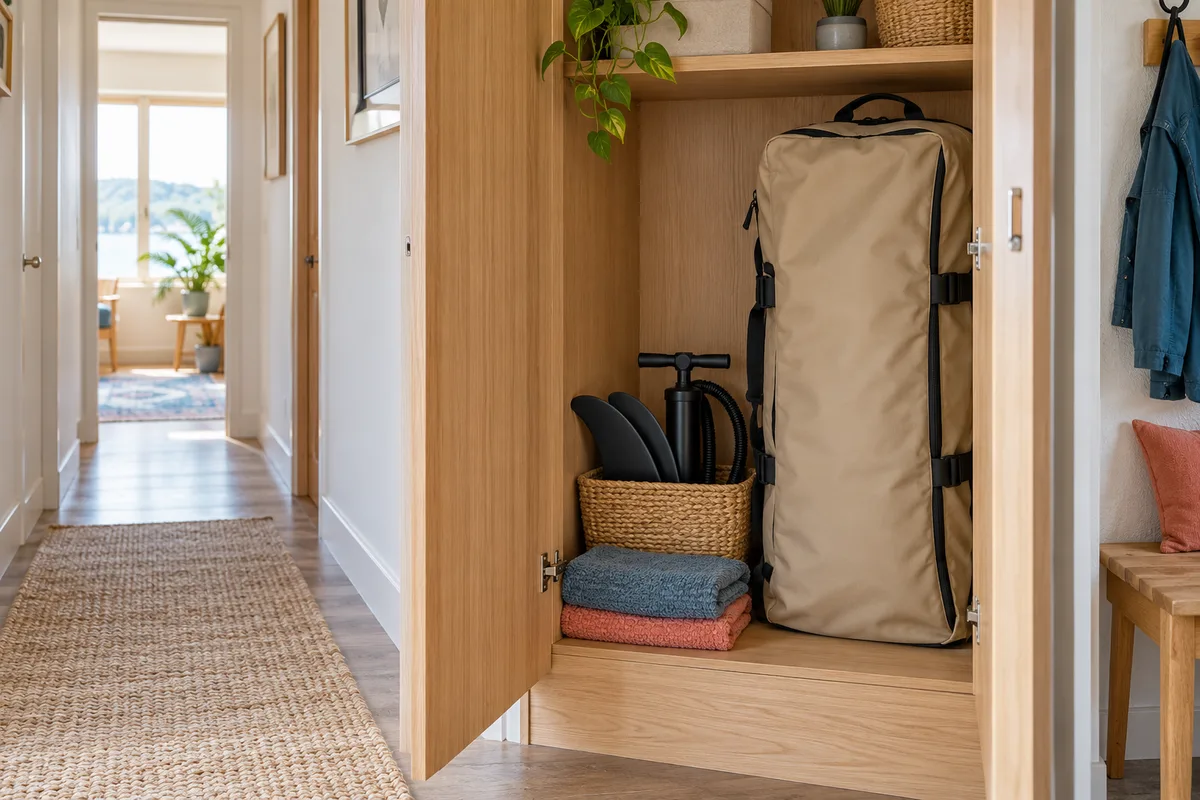
Compare the space, support and care decisions that differ between hard SUPs and inflatable boards. Check the instructions for your exact SUP model; guidance differs between makers.
Work through the practical choices
A hard board occupies a long, fixed footprint. Measure a clear span and lifting route, and use supports designed for its shape. Keep it from sliding, being knocked by bikes or tools, or sitting where sunlight and heat conflict with the maker’s instructions. Do not apply inflatable folding advice to a rigid board.
An inflatable can be packed down, but it must be clean and dry first. Check the instructions for your exact SUP model; guidance differs between makers.
Related guides: start with the storage chooser, inflatable board care, garage storage.
Compare the route, not just the floor space
For a hard board, measure the narrowest turn between the entrance and the proposed supports. A clear wall is of little use if you cannot carry the board through the door without hitting the nose or tail. With an inflatable, measure the packed bag after you have dried and packed your own kit; a retailer’s board dimensions do not tell you the bag footprint.
Write down the stored length, width and height; the lifting route; whether drilling is allowed; and the maker’s permitted storage orientation. If those four checks do not agree, choose another position before buying storage hardware.
Sources & further reading
Manufacturer guidance checked 2026-10-25. Check the instructions for your exact board and model before acting.