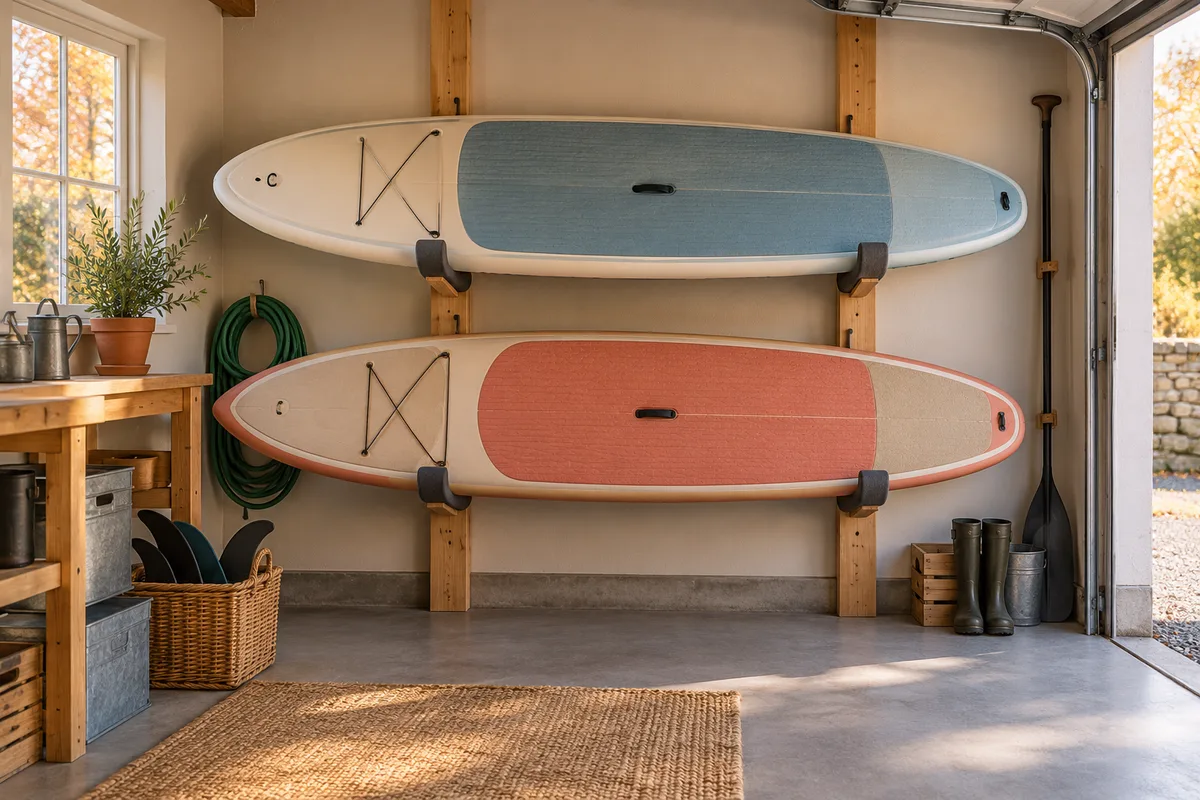
Start with the board you own, the space you can actually reach, and how often you use it. An inflatable can be packed away when dry; a hard board needs a permanent footprint roughly its full length. There is no single storage method that suits every board or home. Follow your own maker’s manual for inflation, deflation, cleaning and storage conditions.
Choose the board’s storage state
If you have an inflatable, decide whether to keep it inflated between frequent outings or deflate it when space is tight or it will be unused for a while. Check the instructions for your exact SUP model; guidance differs between makers.
Measure before choosing a rack
Measure the board’s length, widest point and thickness, then measure the route into the storage area: doors, stairs, loft hatch and the space needed to lift or turn the board. Check the rack maker’s stated board compatibility and load rating against the board and any accessories. A ceiling position can free floor area but must leave safe access and adequate clearance; a wall rack can be easier to reach but still needs suitable fixing points. Do not choose by a product photo alone.
Make the space ready
Before storage, rinse away salt, sand and dirt where your maker recommends it, then let the board and kit dry. Check the instructions for your exact SUP model; guidance differs between makers.
A quick decision
- Small flat: a clean, dry inflatable packed as its maker directs is usually the easiest footprint.
- Garage or shed: consider humidity, temperature, pests and sunlight before storing either board type there.
- Several boards: map wall and ceiling space, then confirm every rack’s instructions and capacity.
Use the inflatable storage guide, wall rack guide or ceiling storage guide for the next decision.
Start with a short storage record
Keep a note of your board’s model, its manual, the stored dimensions and the space available. For an inflatable, include the actual packed-bag size; for a hard board, record the support positions its maker permits. Add the route through doorways and the area you need to lift and turn it.
Before purchasing, separate what is confirmed from what you still need to ask. A seller’s photo can show the type of storage without confirming thickness, capacity, fixing suitability or clearance. Use the chooser to organise these questions, then check the final setup against the equipment instructions.
Sources & further reading
Manufacturer guidance checked 2026-10-25. Check the instructions for your exact board and model before acting.