Inflatable SUP brands give different instructions about storage pressure and deflation; check the exact model manual. Check the instructions for your exact SUP model; guidance differs between makers.
Work through the practical choices
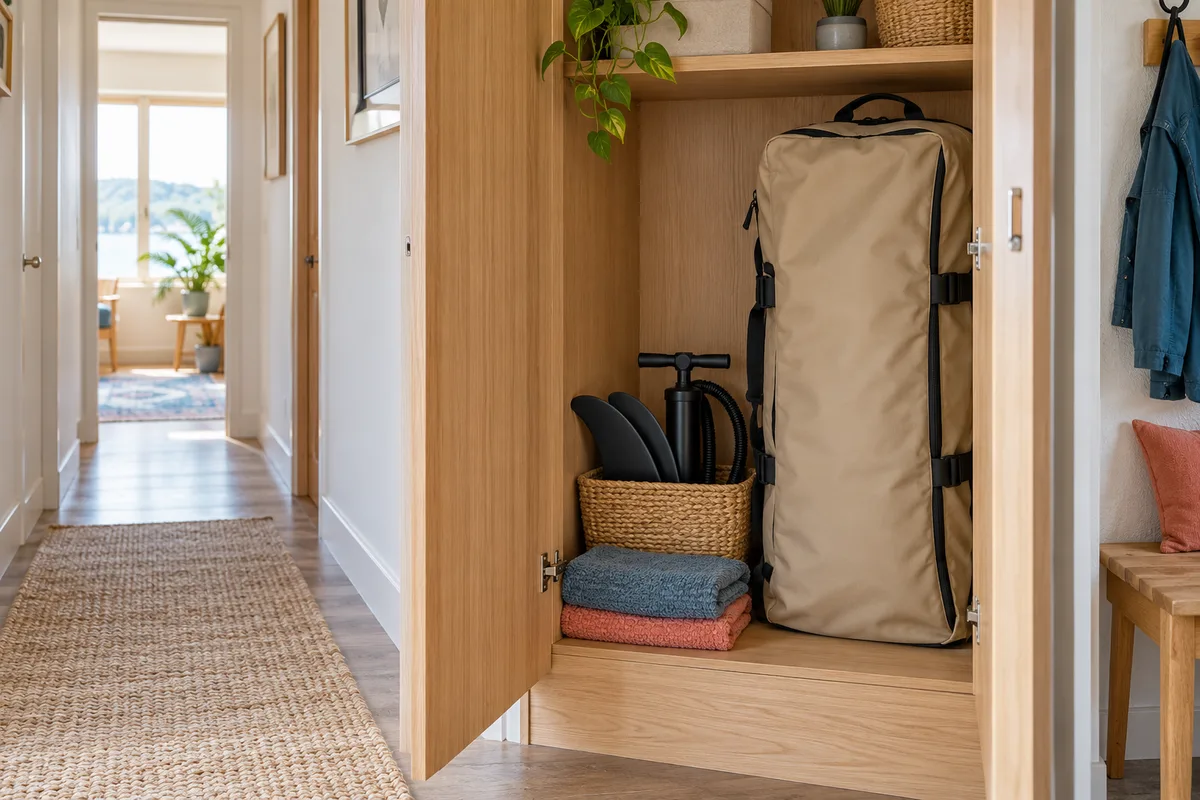
Deflating makes a board easier to store in a flat, cupboard or car boot. The trade-off is extra time to dry, fold and pack it carefully. Follow the manufacturer’s folding sequence, and avoid compressing the fin box or creating sharp bends. Do not pack a board that is still wet just to save room.
If the manufacturer permits inflated storage, it can be convenient between frequent outings, provided there is a clear protected space. Support it as instructed and keep it away from direct sun and heat. Check the maker’s pressure directions for long storage, and never borrow a PSI figure from another brand or board model.
Related guides: start with the storage chooser, inflatable board care, garage storage.
Choose after checking your exact manual
Write down the permitted storage state for your board model, the available clear space and the length of the planned break. Packed storage can save room, but only after completing the maker’s preparation steps. Inflated storage keeps the full board footprint and still needs an approved support method.
Do not treat the pressure used for paddling as an automatic storage setting. If the manual is unclear about a longer break, temperature or support orientation, ask the board maker. Keep its answer with the manual rather than turning one brand’s guidance into a rule for the next board you buy.
Sources & further reading
Manufacturer guidance checked 2026-10-25. Check the instructions for your exact board and model before acting.